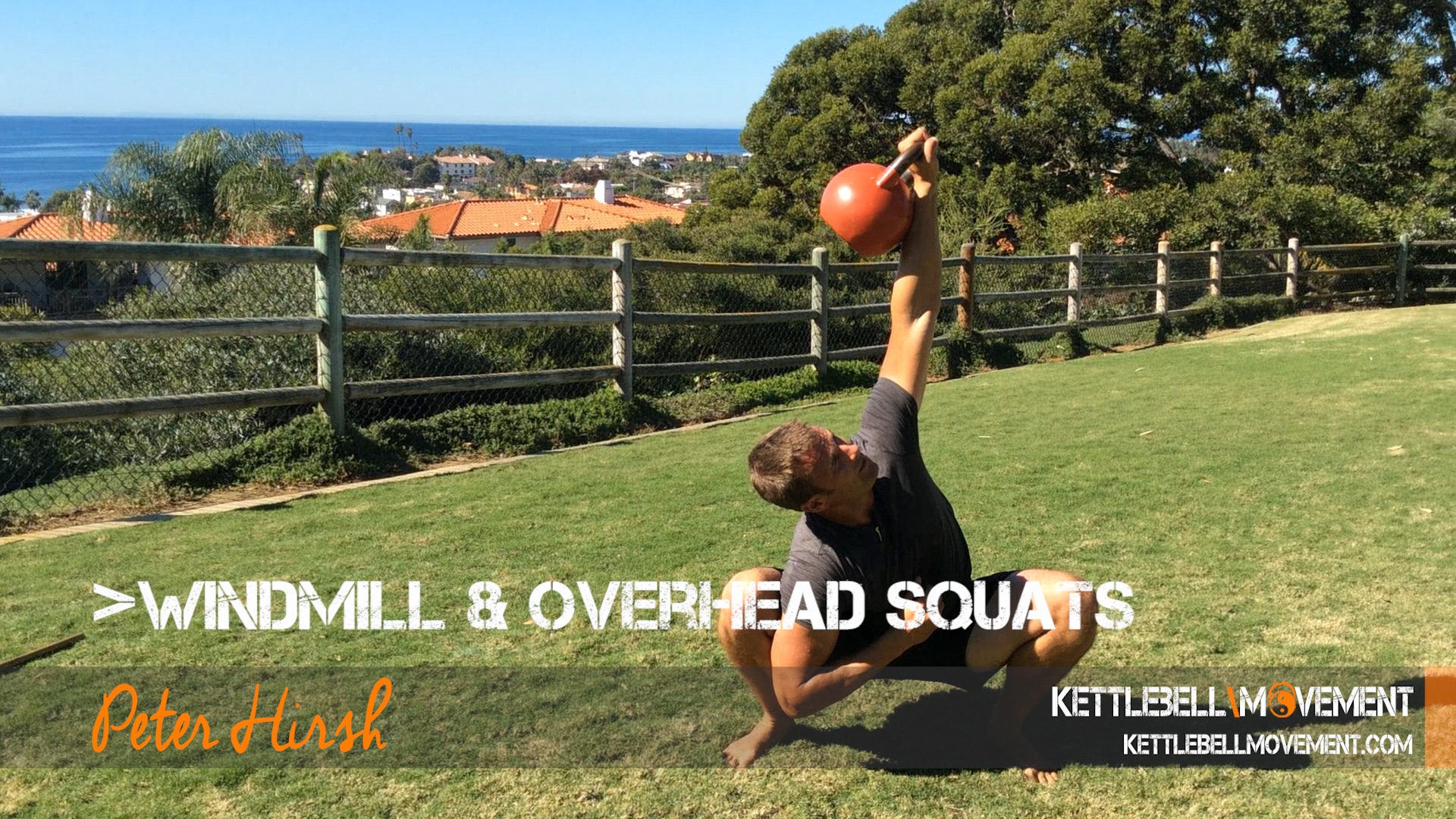
Windmill and Overhead Squats:
Thank you for joining me this Friday for a lesson on the overhead squat and windmills. These two exercises are some of the most important lifts you will ever perform. That said, they aren’t for the novice practitioner and while they develop excellent flexibility, they require a certain degree of flexibility to be present before you even begin. If you are unable to achieve the overhead loaded lat position because of tightness in your shoulders, this exercise isn’t for you quite yet. You should be able to lock your elbow and sink your shoulder down, loading the weight into your lat. In this position, the weight should be balanced over your plumb line and should take little effort to hold. The exercises I am going to teach you today will use flexibility in your shoulders and hips as well as stability in your shoulders. The beauty of this kind of training is that it develops flexibility in the most important joints of your body (shoulders and hips) faster than almost anything else you can do. The reason I make such a bold statement is because the joints are stabilizing throughout the entire range of motion and therefore your nervous system learns strength within a range of motion. This is something you won’t get out of static stretching.
The Windmill
The windmill is a movement from the hips, beginning in the overhead loaded lat position. With straight legs, you will use only your hips as the pivot point, make sure you don’t round your torso. The movement in your hips is mostly sideways and slightly back. Watch the bell overhead and keep it in it’s neutral balance point. As the angle of your torso changes, so will the angle that the bell loads into your lat, eventually loading into the traps and moving the shoulder blades together. Don’t take your eye off the bell as you come down and back up to an overhead loaded lat lockout. You will feel this exercise in your hamstrings and adductors (inner thigh) if you’re doing it correctly, as well as your obliques and shoulders.
The Overhead Squat
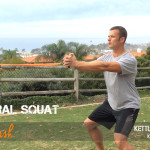
The overhead squat is a similar movement, in fact, you could say that there is a slight windmill in the overhead squat. This exercise will teach you how to keep the heavy weight completely neutrally loaded as you move your body, and the weight, up and down the plumb line. Watch the bell as you squat underneath the weight using torso rotation to help keep the bell neutral. Even the strongest and most flexible people utilize some degree of forward lean when performing a squat. That forward lean with the torso would pitch the bell forward, even slightly, making it feel exponentially heavier. The rotation will help to solve this and eventually allow you to get to rock bottom. I personally love this exercise and I am a firm believer in it’s benefits for anyone that is able to perform it. For flexibility, core strength and teaching your body and nervous system neutral posture, this is one of the best exercises out there. Most of your postural problems and chronic joint pain stem from the nervous system not using your muscles properly. Your nervous system is responsible for most of your muscle tightness and improper motor patterns.
For unbeatable core strength, flexibility and posture, learn to lift weight overhead, and then move under the weight when you are able to keep it stable in the overhead loaded lat position. The turkish getup, an exercise that has become infamous in the functional training community, is all about moving under the weight. Practice these two exercises regularly and watch all of your lifts improve significantly. Also observe the carryover that your new found capabilities give you in the real world. You can bet that we will use these exercises in future workouts, so practice up!
Peter Hirsh






1 Comment
Kettlebell Movement | Kettlebell Endurance - Kettlebell Movement