Category : Health

Blog Fitness Health Lessons

Common Question: How Do I Spot Train?

Hello and welcome to Kettlebell Movement!

Many people ask me how to get rid of fat in a certain area of their body, under the impression that training a muscle burns fat in that specific area. While it is possible to notice better muscle tone from training one muscle at a time, it won’t help you burn fat around the muscle being trained. The specific areas that your body stores fat are based upon hormones and genetics. If weight loss is your goal, eating right and exercising using high energy output exercises are your best bet. For some people, removing hormones from foods, pharmaceuticals or supplements may also be beneficial. If you are using the birth control pill, eating soy, or consuming meats injected with steroids you may want to eliminate these things to see how they have been effecting you. These can make your body store fat in places that it wouldn’t normally want to as well as make it tough to lose.

Read More
Blog Fitness Health Lessons

How Often Do I Train

Hello and welcome to Kettlebell Movement!

Today I am addressing how often you should train every week. I hear this question from every client I ever meet, and rightfully so. Most people want to get as much benefit from their time training as possible, but don’t want to over do it and get injured or burned out. Excessive exercising is common for people with extreme personalities, these people often go up and down in weight as they go from one extreme to the other. For other people, not training enough will stop them from reaching their goals and kill their motivation.

Read More
Blog Fitness Flexibility Health Workouts

Lengthen and Strengthen Workout


Lengthen and Strengthen Workout:

When it comes to performance both in the gym and out of it, flexibility is the biggest limiting factor for many people. Many people think they are weak in a certain area based on previous experience and are surprised to find out that they are just lacking mobility. In order for your body to function properly your muscles must be able to relax just as well as they can contract. If this isn’t the case, you will be fighting the resistance in your own body combined with that of any weight you are attempting to lift. When your muscles learn to relax properly, your lifting capacity will increase dramatically. I use the term learn for a reason, because flexibility is more about your mind and nervous system than it is about short muscles. In fact short muscles rarely have anything to do with your immobility.

This workout is designed to teach your nervous system strength within a range of motion, something that stretching simply cannot do. While stretching does have benefits when done properly, it isn’t able to teach your nervous system how to perform under tension the way dynamic range of motion can. Today’s workout is designed to help you gain that strength within a range of motion.

Today’s Workout:

  • Cossack squat - Five per leg, alternating
  • Straight leg deadlift - Twelve total
  • One leg deadlift - Six per leg
  • One leg clean - Six per leg
  • High/low Windmill - six per hand
  • Split lunge - Six per leg

This workout will open up your hips in both the flexor muscles and the extensors (glutes and hamstrings). It will also open up your shoulders with the windmills and even take you through some power phase exercise with the one leg cleans. As you can tell, there is a lot of balance involved too, so take your time and be methodical. You may find bare feet are best for balancing, a hard gym floor may also be easier than grass or sand. Feel free to repeat this workout for up to three rounds, or just add it to your existing routine. It makes a great warmup for more intense training days and works great as a stand alone practice. Remember, anytime you lengthen muscles beyond what they are used to, they will become much more sore than if you train them within their normal range of motion. Take it easy at first and you may be surprised how sore you get. If you keep training these exercises, you will develop amazing flexibility that will have a dramatic impact on your other lifts and your daily life. Have fun!

Peter Hirsh

Read More
Blog Health Nutrition Weight Loss

Eating Paleo and Kettlebell Training

Eating Paleo and Kettlebell Training:

Many of my clients come to me for kettlebell training and often resist talking about their diet at first. However, most know on some level that these changes must happen one at a time in order to ensure long term success. Diet is a very important aspect of health and I often encourage people to follow the paleo diet. The paleo diet focuses on doing what is in sync with human biology and only eating the foods that are ancient to man. Kettlebell training is also a paleo way of exercising, it is ancient in your biology and works with nature. Eating paleo often helps people see an improvement in their sleep, energy and overall health when eating this way. By eating only foods that are in sync with your biology and eliminating all processed foods you will help reshape your body with minimal effort.

I have been featured on many different paleo blogs including Paleo Mom and Whole9 as well as Paleo Magazine. Many people see that I support this way of eating and ask me how I get enough carbs while eating paleo and kettlebell training. First, it’s important to remember that what works for you may not be the same as what works for someone else. I encourage you to take a metabolic typing test to help you find out the ratio of fats, carbohydrates and protein your unique body requires. Listen closely to your body, if you know you need more carbs or more protein than make sure to adjust your diet accordingly. While paleo eating may lend itself well to the “polar” metabolic type, the equatorial types need more carbs to maintain normal energy.

Despite some beliefs, it’s possible to still get enough carbohydrates in your diet through only whole foods and avoiding agricultural foods such as grain and legumes. Both grains and legumes aren’t considered paleo but root vegetables are. Sweet potatoes and squash are two excellent foods to include in your diet for increased carbohydrates. If you end up training extra hard and need a little booster, a bowl of rice probably isn’t going to cause you any setbacks either. In general I recommend trying to avoid grains. However, if you do choose to eat some grains, sprouted are a better alternative. Grains and legumes contain anti nutrients that can cause damage to your body whereas sprouted grain minimizes the anti nutrient factor. Sprouted grains are also gluten free and are therefore even less likely to cause digestive distress.

When kettlebell training or participating in any challenging physical activity it’s extremely important consume enough high quality fats and protein. When minimizing sugar in your diet and eating paleo your body learns to get it’s energy from fat rather than sugar. My post workout meals always include a good amount of high quality protein and fat. As I mentioned before, what works for me may not be exactly what your individual body needs so make sure to listen to what it’s telling you.

Thank you for reading,
Peter Hirsh

Read More
Blog Fitness Health Lessons

Lunge Progressions: 8 Variations Of The Lunge

Lunge Progressions: 8 Variations of the Lunge:

The cooler mornings here in San Diego have led to some really nice outdoor workouts. Today I am going to take you through eight variations of the lunge, using little to no equipment. The lunge is one of the seven primal movements in human physiology and is often combined with other primal movements like a push, twist or pull in every day life. As you go, you will notice the lunges becoming progressively more challenging and demand more strength, flexibility and focus. Lunges are a fantastic exercise for training your balance and hip flexibility. If either of these are a problem for you, start slowly and work your way up.

Backward stepping lunge

You will find these are the easiest method for learning the lunge and getting used to the balance. Anyone with tricky knees will appreciate this progression, as it allows you to completely control the pressure on your knees.

Forward stepping walking lunge

The forward stepping lunge is a little bit more challenging than the backward stepping lunge and can be turned into a walking lunge for many variations.

Lunge with rotation

Lunges can be combined with various movements in the upper body for variation. The lunge with rotation is one of my favorites.

Lunge and press

Combining lunges with a shoulder press will demand a high level of tension in your core, this is a full body exercise that you will truly feel all over your body.

Split lunge

The split lunge is an excellent way to lengthen out tight quads and hip flexors, which is a common problem for people today. Not only will these lunges lengthen your hip flexors but more importantly they will teach them strength in greater range of motion. Beware, these will make you sore!

Tactical lunge

The tactical lunge will make the balance of the lunge more difficult because the bell will swing side to side while your feet are in a long, linear stride. Make sure you keep your back flat and sit down into your hips. People often round their backs trying to get down low enough to transition the bell.

Power lunge

Like the split lunge, these will make you very sore. However, the split lunge focuses that soreness in your quads and hip flexors and these will be more of an all over soreness. If you have knee pain or previous injuries, be careful with this progression.

Lunge figure eight

Swinging a kettlebell from hand to hand, switching under your leg with each lunge. This progression will take strength, stability, balance and determination, proceed with caution!

I always talk about how important good technique is and I don’t want to sound like a broken record, but there’s nothing different about lunges. You should take them from one progression to the next, slowly, and use excellent form. If there is a variation you are unable to perform with good technique then you should regress to the previous variation and build strength before moving on. Stay tuned as we utilize these lunges in future workouts and as I introduce you to even more variations to mix things up.

Read More
Fitness Health Lessons

7 Primal Movements For Fitness

7 Primal Movements For Fitness:

Today I am going to talk about the 7 primal movements. Regardless of the equipment available to you, if you use these motions in the gym you are guaranteed great results. Training the seven primal movements will help you create strength and flexibility in all ranges of motion. It will keep you focused, build coordination, and improve your cardiovascular strength. I do not advocate the muscle isolation machines and exercises that were adopted by bodybuilders for anyone with a goal of health. Muscle isolation develops useless strength in the real world. It will cause you to lose range of motion and pound away at your joints. Which, in my opinion, misses the point of exercise entirely.

What is the point in exercise? Well, amongst many other benefits, exercise helps create body unity.

There are 7 primal movements for fitness that are the basis for all human movement. When you prepare your workout plan, instead of training individual muscles, train these movements.

Bend to extend – This is a hips back movement, loading into your legs with a flat back. Keep your feet flat and forward. This can be performed bodyweight or in dozens of other variations. This movement works your glutes, back of your legs (hamstrings), and your lower back.

Squat – This movement is downward with your hips. Keep your bodyweight in its neutral gravity line with your back flat. Over time develop the range of motion that will take you to “rock bottom.” At rock bottom the forward lean is minimized, try to keep your torso almost upright. This movement is all about strength and flexibility and works every muscle in your legs and core.

Lunge – This is a stabilization and balance training exercise. When performed properly it is great for lengthening tight hips and creating pelvic floor strength. Lunges will make your quads and hip flexors sore from the long range of motion and will require more core strength to stand up out of than the squat and deadlift.

Twist – All movement begins with rotation, twisting through your core is extremely important for strength and flexibility. Every step you take has rotation in the thoracic spine. For injury prevention train this movement in your practice. It will keep your core strong and mobile, unify your body and tone up those midsection muscles!

Push – This is your upper body muscles pushing things in various directions. In the real world, you would have to do this frequently with many different objects and in many different forms. This movement trains your chest, shoulders and triceps differently depending upon the lift.

Pull – Your upper body muscles pulling weight toward you, referred to as a row, or pulling your bodyweight upward, like the pull up. This trains your back, biceps and grip. There is a version of pulling out there for everyone. Pulling can help correct the forward shoulders that have become so common among people from spending so much time at computers and iphones.

Gait – This means variations of walking, jogging, running and sprinting. If you train the previous six movements safely and effectively, it will set you up to have the posture, flexibility, strength and endurance to run. I often tell people, don’t run to get fit, get fit so you can run!

When you train opt for free weights and body weighted exercises and steer clear of one size fits all machines that spot train muscles. Unless your goal is to get very bulky, muscles isolation isn’t worth the drawbacks of loss of flexibility and excessive wear on your joints. By training full body free weight exercises, you will improve your health, become real world strong and reshape your body at the same time!

Read More
Blog Fitness Health Workouts

Peter’s London Kettlebell Workout, Part 2

Peter’s London Kettlebell Workout, Part 2:

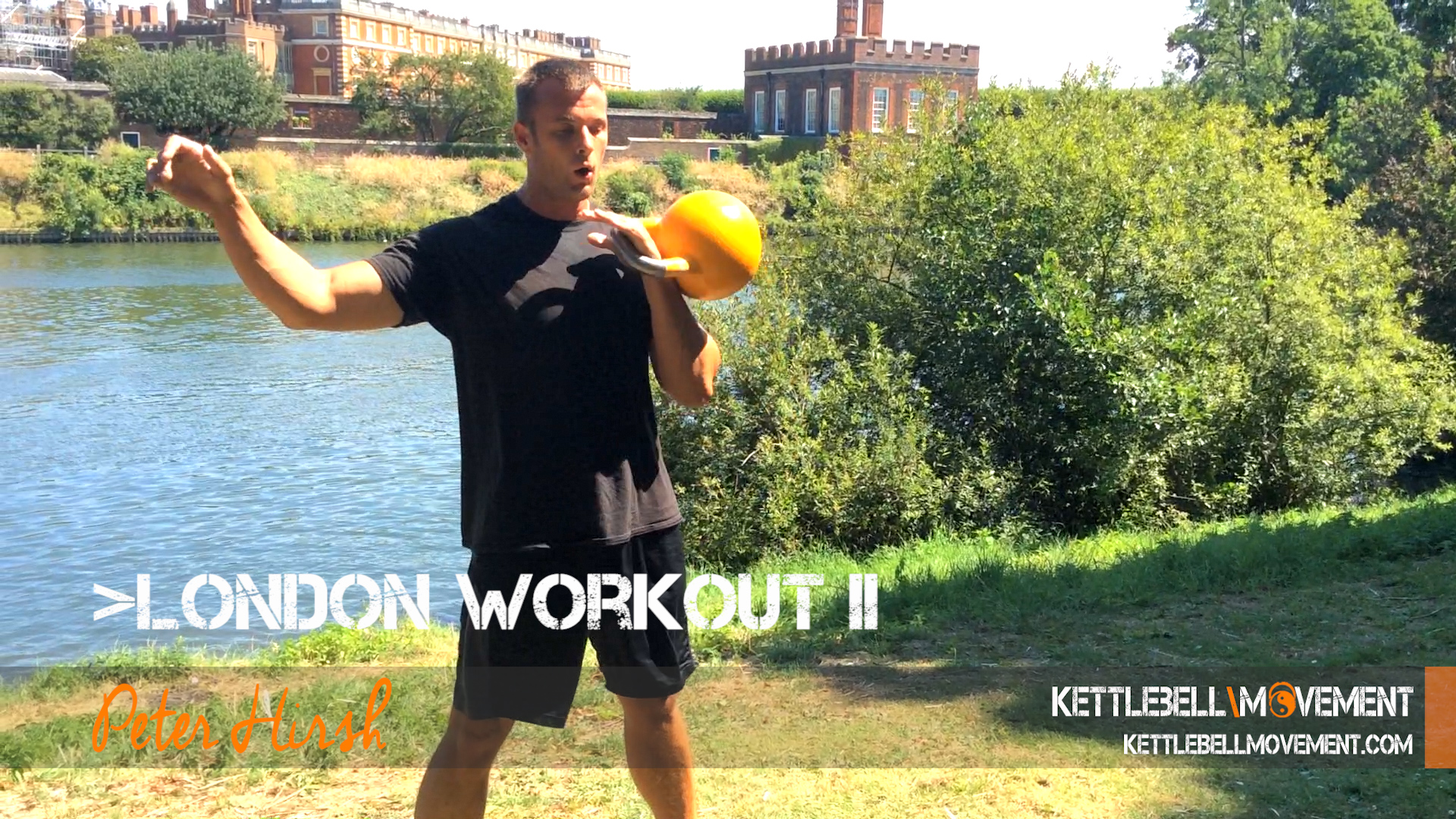
Today we are so fortunate to be working out in front of Hampton Court Palace in Hampton Court, England. In today’s workout I am going to help you see the difference between hard style and pro-style kettlebell movements. By using an inefficient variation, hard style, and then the same exercise more efficiently with girevoy sport style. You will see how one variation develops more maximum strength and the other more strength endurance. Make sure you start every exercise with your non dominant hand then switch to your dominant hand.

Before you begin practicing this session, you should have already learned the three basic lifts; the kettlebell swing, the kettlebell clean&press, and the kettlebell snatch. While this is a lesson about learning the differences between the two styles, it isn’t a great time to be learning the fundamentals. You should already have them down by now.

You will not need very much in the way of equipment for this workout. I am using only one bell for the entire session. I recommend using a relatively light weight your first time through because this session will have an accumulative effect on your strength and endurance.

Maximum strength vs strength endurance:

Swing

Maximum strength round:
Twelve reps of two handed swings.
(Two sets)

Strength endurance round:
Twelve left, twelve right, one handed swings.
(Two sets)

Clean

Maximum strength round:
Eight cleans from dead per hand.
(Second set: Six cleans from dead per hand)

Strength endurance round:
Sixteen circular cleans per hand.
(Second set: Twelve per hand)

Press

Maximum strength round:
Six military presses per hand to overhead lockout.
(Two sets)

Maximum endurance round:
Twelve push-press per hand to overhead lockout.
(Two sets)

Snatch

Maximum Strength round:
Six Snatches per hand from dead to overhead lockout, rack the bell on the way down.
(Two sets)

Maximum endurance round:
Twelve ballistic snatches per hand to overhead lockout, no rack coming down.
(Two sets)

You may be sore just about everywhere, but not an overwhelming soreness that keeps you from standing up out of a chair. The goal is a mild soreness all over, especially in your glutes, hamstrings, abdomen, back and shoulders. While the majority of our training will focus on hard style exercises for safety and benefit, the sport style endurance lifts can be a fun change of pace. Another pointer to note is that hard style cleans and snatches can also be performed from a swing, I trained them from dead today for greater contrast. The push presses in the endurance round are not exclusive to girevoy sport and would be used in hard style training too. I used these two variations as a way of comparing maximum strength and strength endurance.

I hope you enjoyed today’s session and the beautiful British backdrop, I will see you next Wednesday for our next lesson.

Read More
Blog Fitness Health Lessons

Learning to Deadlift

Learning to Deadlift:

In todays video I am teaching my sister how to perform a body weighted deadlift movement. The greatest challenge will be developing the motor pattern rather than muscle fatigue or cardiovascular endurance. Sometimes flexibility can be a limiting factor, usually in the hamstrings or hip flexors. This can usually be trained out with repetition. This isn’t the first deadlift instructional video I have posted and it probably won’t be the last. Today’s main idea is to be able to show you someone learning to deadlift for the first time. You will notice how I make adjustments to what seem to be insignificant or barely noticeable deviations, the little things really add up. Please take the time to be as specific with your form and remember that you are always practicing!

In this video I make a few minor corrections to my sister’s foot placement and instruct her on the use of her hips and glutes. Otherwise, she made very few mistakes that caused concern with the exception of her knees moving forward with just about every repetition. Over the course of a few sessions, I would retrain that motor pattern and increase her flexibility to prevent this from happening. It is unlikely that your deviations in form will be the same as Emily’s were and it’s even less likely that you won’t have any when deadlifting for the first time. Take a good look at your technique and ensure your knees aren’t going wider than your feet or going knock-kneed. Make sure you keep your feet flat from side to side and front to back, many people lift their heels at first. Once your feet are flat and your knees are in proper alignment, the next most common mistake I see is rounding of the back. Emily didn’t make this mistake once, but it’s very common. Make sure you keep your back as flat at the bottom of the deadlift as it was when you were standing. I also mention how keeping your head in alignment with your spine is important. A common mistake people make is fixing their eyes on something in front of them, causing their neck to extend and flex with every repetition.

The deadlift is the basis for so many other amazing strength building exercises and I will teach it in as many ways as possible. In addition to progressing onward to more challenging variations, always come back to the deadlift for the base building exercise that it is. I recommend training deadlifts on days where you won’t be using your grip for other exercises. When you start adding weight to your deadlifts your grip will work very hard. It’s not unusual for the grip to fail before the lifting glutes and hamstrings do. Many people assume they are doing something wrong when their grip fatigues first, this isn’t usually the case. Other people look to lifting aids to help them grip the weight better such as lifting straps. Personally, I keep a bag of chalk in my car and don’t recommend anything more than that to my clients.

Keep training this lift until you have nailed it, then incrementally add the appropriate amount of weight. We will build off this foundation with almost everything we do together in our workouts. Try to stay focused and patient with your body.

Thank you for practicing with me today, I will see you on Friday for a workout!

For more information on deadlifts click here.

Read More
Blog Flexibility Health Lessons Workouts

Kettlebell Traveling Health Tips

Kettlebell Traveling Health Tips:

I’m taking my bride to be on a holiday in England to visit my family and see where I grew up. I am able to borrow some kettlebells from Box Bell Fitness in Warfield England so I will be set when I arrive. Traveling can make it difficult to stay healthy for many reasons and finding good food to eat and staying active are two of the biggest challenges. To continue to eat healthy during this trip we will follow the same rules as anywhere. We will continue to try and eat whole, organic food and use the paleo diet as a template. In order to stay active on our trip I will borrow some kettlebells and try and get in a few training sessions. However, I anticipate the majority of our activity will be walking around all of the places I used to go when I was a child, including London!

With a quick layover in Houston before a much longer flight to Heathrow, I am demonstrating some dynamic range of motion to keep the muscles from cramping up. I start with some good mornings and then do some rock-bottom squats to get my blood flowing and move my muscles in a full range of motion. You can also see Emily performing some kick stretches. These lengthen both your hip flexors and hip extensors (glutes and hamstrings). Very important muscles to move before a long flight, it also helped release some energy from the excitement of our travels!

On our trip, we will have access to a full kitchen so we won’t have to rely on only restaurant food that would probably make us feel sick. When you eat a mostly organic diet of only whole foods your body responds quickly when you treat it badly. I am going to do push ups, squats and lunges everyday, and if I can find an acceptable spot, pull ups. As I mentioned, I am also going to borrow a few ketttlebells that will keep me in my strength training routine. Once I have adjusted to the time change, I should be good to go! I will be adding a couple more videos while we are traveling and try and put together a workout from somewhere very British. Meanwhile, I will spend some time enjoying the British lifestyle and maybe have a pint.

Hope you enjoy joining me on this adventure!

Peter Hirsh

Read More
Health Weight Loss

Basic Weight Loss Tips

Basic Weight loss Tips:

Maintaining a healthy diet, and therefore a healthy body weight, is all about preparation. It doesn’t hurt to have a few recipes that look tasty already picked out before you go to the grocery store so you know what to buy. Many paleo recipes follow the kind of traditional diet that I encourage. However, some of them don’t. Try to stick to the meat and veggie paleo dishes and avoid the paleo versions of cookies or breads.

The Grocery Store

Step one: The grocery store. Avoid anything with a list of ingredients. Instead buy only whole organic foods whenever possible. I will talk more about organic foods and organic certifications in the future to help you separate fact from fiction.

Always remember that we are as different on the inside as we are on the outside, the foods that will make you thrive might make another person sick. There is no cookie cutter fix for health or weight management. You will have to become a great listener to the signals your body is sending and learn the foods that work well for your unique biology and avoid the ones that don’t. As you remove the standard American diet (SAD) and replace it with healthy whole foods, it will be easier and easier to stay tuned in to what does and doesn’t work for you. Your body will become finely tuned and when anything disagreeable enters it, you will recognize the signals right away. This is a sign of excellent health.

What to buy:

Meat - I highly recommend pasture raised meats as opposed to commercial feedlot meat. Buy a cheaper cut of pastured meat and learn to cook something tasty with it instead of buying an expensive cut of feedlot meat and just throwing it on the grill.

Eggs - If you can, get free range eggs. There is a big difference in the nutrients of free range chicken eggs compared to confined commercial feedlot chicken eggs. Eat the whole egg and avoid the egg white substitutes.

Vegetables - Pick up lots of different colors; leafy greens, tomatoes, peppers, beets, squash and either white or sweet potatoes in moderation.

Rice - In moderation, depending upon activity levels. Brown rice has more anti nutrients than white rice but white rice is higher glycemic. Both should be limited.

Fruit - Pick up only enough fruit to allow one to two pieces a day, no more.

Herbs and spices - Stock up! I won’t let my kitchen run out of fresh garlic, basil, mint and rosemary and I always have sea salt, cumin, turmeric, paprika, fennel, oregano, chinese five spice, cinnamon, nutmeg, chili powder and cayenne pepper. Herbs and spices are the key to making your whole foods taste amazing, they also have a whole host of health benefits. Make sure to avoid the herbs that have been cold-pasteurized using radiation - buying organic will prevent this.

Dairy - Only high quality organic dairy. Some people will have intolerances to any dairy and should avoid it completely. The majority of my dairy is unpasteurized (raw) and it’s all organic.

Nuts and seeds - Go for raw, organic nuts and seeds and consume in moderation. Also check to make sure they haven’t been cold-pasteurized using radiation.

What to avoid:

Avoid the following foods, they will likely cause you severe inflammation and weight gain, in addition to a whole host of potential health problems.

  • Anything in a brightly colored package
  • Anything with a list of more than three or four ingredients
  • Fortified foods
  • Processed foods
  • Frozen dinners
  • Breads, pasta and other grain
  • Liquid vegetable oils and hydrogenated spreadable vegetable oils.
  • Commercial dairy
  • Salad dressings and other condiments
  • Protein and meal replacement supplements
  • Energy drinks, soda and juice
  • GMO (genetically modified) foods

Your next step is following some simple recipes and learning how to use your herbs and spices. I recommend buying an entire chicken instead of cuts of chicken. See our roasted chicken recipe for a quick and easy way to make a whole chicken. You can even cook the remaining carcass of your chicken into a very healthy stock. I will often make a weekly ration of rice for my active days and use the chicken broth to cook the rice with.

Cooking once and having food for a few days is a great way to save time and money. Roasting big cuts of meat and veggies can help keep you in your healthy habits throughout the week. It’s also a good idea to plan your week’s food out before going to the grocery store. Make sure you aren’t going to run out of food on Thursday and eat restaurant food until you can grocery shop again on Sunday!


Read More
1 2

Affiliate Debug : No cookies are currently set - I am looking for cookies at : /