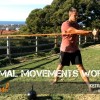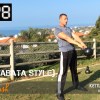
Hello and welcome to another Wednesday lesson on Kettlebell Movement. Today, I am going to teach you kettlebell get downs, a different spin on the turkish get up. This exercise is not as technically challenging as the turkish get up, however, it will require much more flexibility to perform safely. I recommend that before you attempt this exercise you take the time to develop excellent technique with the turkish get up as well as the overhead squat. If you struggle to maintain the overhead loaded lat position in these exercises, due to shoulder inflexibility, the get down is not for you quite yet. Practice the TGU, overhead squats and windmills to develop the range of motion necessary in your shoulders first. You will also need excellent hip flexibility for the get down, so practice your goblet squats to rock-bottom with a flat back.
The get down is one of my favorite moves, it uses the deep overhead squat combined with a slight windmill, to get you as deep down as possible. The main focus of this exercise is on keeping the bell directly over the plumb line of your body. Any deviation front, back or sideways, will make even a light weight feel extremely heavy. This is where excellent flexibility comes in. Tight shoulders will move the bell away from it’s line of neutral gravity and tight hips will prevent you from getting deep enough to reach the ground. Keep your eye on the bell as you learn this exercise, doing so will help you stabilize the weight as your shoulder moves through it’s range of motion. While the turkish get up utilizes a lunge movement followed by a leg-under transition, the get-down uses a squat and doesn’t need the hip bridge or leg transition.
Begin the get down from the overhead loaded lat position with one hand, the free hand, should be unloaded. This exercise is in no way exclusive to kettlebells. In fact, I recommend holding the center of a barbell for added stability challenge, just use a light weight at first. With your eye on the bell, perform the deepest overhead squat combined with a slight windmill to get to “rock bottom”. When you reach the base of the squat, place your free hand flat on the ground and extend your leg (same side leg as free hand) out front. Lower your pelvis to the ground gently, try not to shrug the shoulder of the supporting hand. At this point, you will be in the seated overhead loaded lat position. The leg on the side of your loaded hand bent at the knee, foot flat and the leg of your supporting hand on the ground will be straight out front. Perform the negative of the get up sit-up until you are lying flat on the ground, loaded arm overhead, elbow locked. Do not put the bell down, perform the getup sit-up, place your free hand on the ground and bring your leg back to shoulder width to prepare for the overhead squat up. This is by far the most challenging part. Move your unloaded shoulder inside of the (same side) knee, keep your eye on the bell and stabilize. Stand out of the rock bottom squat, keeping the bell directly over the plumb line. This exercise should be watched on video before attempted as it is very difficult to explain it clearly so that everyone can understand.
The benefit of this exercise is flexibility, stability and focus that will have a direct carry over to your daily posture. In my experience, moving under overhead weight does more to correct bad posture than almost anything else. This is because it teaches your nervous system what neutral posture is. The get up works on the level of the mind and the body to align your posture, helping eliminate chronic back and joint pain. I believe that the get down would be a far more popular exercise, and probably share the same notoriety of the turkish getup, if more people were flexible enough to perform it. Due to sedentary lifestyles and unusual exercise routines, many people lack the range of motion that our highly active ancestors would have enjoyed. Take your time to learn this exercise with little to no weight before increasing the challenge. Also, as I mentioned earlier, when you are ready to progress in weight, consider using something less stable such as a barbell.
I hope you enjoy this exercise as much as I do, once you get it right, you will immediately notice the massive benefits it provides.
To learn more about the turkish getup, click here.
Peter Hirsh